

Getting Your Bookkeeping Off the Ground: Accounting Basics for
New Business Owners
Starting a new business is both exciting and challenging—and one of the most important steps is setting up a solid accounting system.
In this post, we’ll break down the fundamentals of bookkeeping and accounting, explain key financial statements, and introduce you to our specialized services including IFRS and GAAP accounting.
Whether you prefer a manual approach or computerized software, these basics will help you get started with accurate, organized financial records.
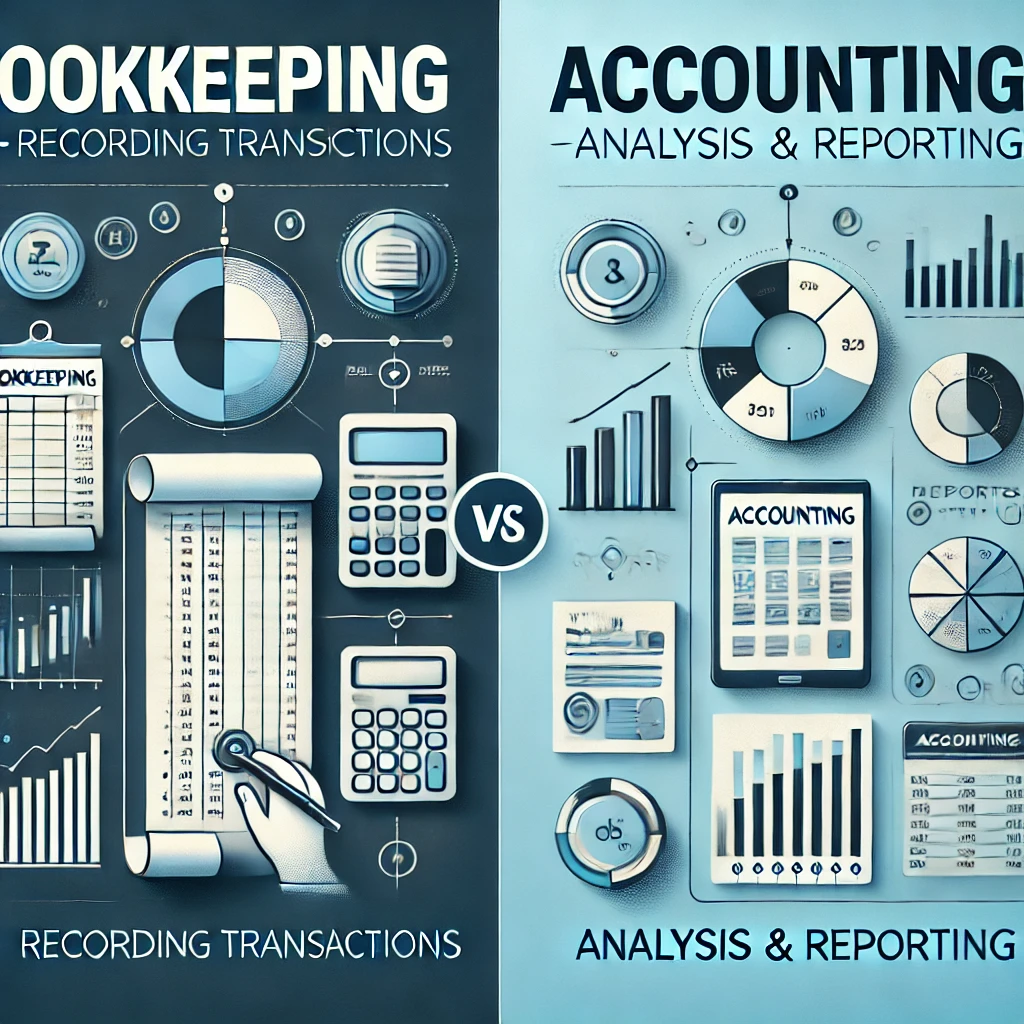
Bookkeeping vs. Accounting?
Bookkeeping is the process of recording all of your business’s financial transactions.
It involves documenting sales, purchases, receipts, and payments in a systematic way.
Whether you maintain a physical ledger or use modern accounting software, bookkeeping provides the data foundation you need for accurate financial reporting.
Accounting goes a step further. It not only involves recording transactions (i.e., bookkeeping) but also classifying, summarizing, analyzing, and interpreting the financial data.
The end result is the preparation of key financial statements that show your business’s performance and financial position.
Understanding Income and Expenses
At the heart of any business’s financial performance are its income and expenses.
- Income (Revenue):
Money earned from sales, services, or other business activities. - Expenses:
The costs incurred in running your business—such as rent, utilities, salaries, and supplies.
The difference between income and expenses determines your net profit or loss for a period. Keeping track of these elements is crucial for understanding your business’s profitability and for making informed decisions.
The Income Statement:
Your Profit & Loss Report
The Income Statement (or Profit & Loss Statement) summarizes your business’s revenues and expenses over a specific period (e.g., monthly, quarterly, or annually). Here’s how it works:
- Total Revenue is listed at the top.
- Expenses are subtracted from revenue.
- The result is your Net Income (profit) or Net Loss.
This statement helps you assess how effectively your business is generating profit from its operations.
The Balance Sheet:
Assets and Liabilities
The Balance Sheet provides a snapshot of your company’s financial position at a specific point in time.
It is based on the fundamental accounting equation:
Assets = Liabilities + Equity
- Assets:
Resources your business owns (e.g., cash, inventory, equipment). - Liabilities:
Obligations your business owes to others (e.g., loans, accounts payable). - Equity:
The owner’s interest in the business, representing the residual value after liabilities are subtracted from assets.

A well-prepared balance sheet not only shows what you own and owe but also helps assess your business’s solvency and financial health.
Double-Entry Bookkeeping Explained
Double-entry bookkeeping is the cornerstone of modern accounting.
Every financial transaction affects at least two accounts.
For example, when you make a sale on credit:
- Debit: Increases your Accounts Receivable (an asset).
- Credit: Increases your Sales Revenue (income).
This method ensures that the accounting equation always balances. If the total debits equal total credits, your books are in order.
Example T-Account:
Equipment Purchase on Credit:Equipment Account (Asset):
Debit Credit $500 Accounts Payable (Liability):
Debit Credit $500 This T-account example shows how buying equipment on credit increases your assets and liabilities equally.
Our Specialized Services:
IFRS & GAAP Accounting
We understand that businesses operating internationally have unique financial reporting needs. That’s why our services include:
IFRS Accounting
- What is IFRS?
The International Financial Reporting Standards (IFRS) are principles-based standards used by more than 140 countries. - IFRS offers flexibility and focuses on the economic substance of transactions rather than strict rules.
- Ideal for:
Companies with global operations or those planning to expand internationally.
GAAP Accounting
- What is GAAP?
The Generally Accepted Accounting Principles (GAAP) are rules-based standards primarily used in the United States. - GAAP provides detailed guidelines that ensure consistency and comparability in financial reporting.
- Ideal for:
Companies operating primarily in the U.S. or those who require highly detailed financial reporting.
Dual Reporting for International Customers
For international clients, we offer the unique ability to maintain two sets of books for the same company:
- One set adhering to IFRS
- Another set following GAAP
This dual approach ensures that you meet the financial reporting requirements in all relevant jurisdictions.

sUMMARY
Setting up a strong accounting foundation is crucial for your business’s success.
By understanding the basics of bookkeeping, the components of financial statements, and the principles of double-entry accounting, you’re well on your way to maintaining accurate, transparent, and useful financial records.
And remember, whether you need IFRS or GAAP reporting—or even both—we’re here to help you navigate the complexities of financial accounting.
If you’re ready to streamline your financial processes and ensure your books are always in order, contact us today to learn more about our comprehensive accounting services.
Disclaimer: This post is for informational purposes only.
Please consult with us for advice tailored to your specific business needs.